The first project by Next Folio Collective CIC
What happens when young people are trusted to create Shakespeare together?
That was the question behind High School Hamlet.
Beginning in January 2026, High School Hamlet was a self-funded research and development project that explored a different way of making theatre. Rather than presenting young people with a finished script and a fixed vision, we invited them to collaborate in shaping every stage of the creative process.
Over six months, thirteen young people aged 16–19 worked together to explore Shakespeare’s Hamlet through discussion, improvisation, rehearsal, and performance. Alongside acting, participants took on roles including directing, stage management, script adaptation, graphic design, costumes, publicity, and technical theatre.
The result was not simply a production of Hamlet. It was a shared creative journey that demonstrated what can happen when young people are trusted with genuine responsibility.
A Project That Changed As It Grew
Like all good research, High School Hamlet didn’t follow exactly the path we expected.
We began with the idea of using artificial intelligence to support the adaptation process. The group rejected the idea, choosing instead to develop the script through discussion and collaborative editing.
We assumed that moving the story into a contemporary setting would naturally lead to modern language. Instead, the young people unanimously chose to keep Shakespeare’s original words, believing they carried an emotional power that shouldn’t be lost.
As the project developed, the group also decided to increase rehearsals from one evening a week to two, driven entirely by their commitment to creating the strongest production they could.
Rather than following a predetermined plan, High School Hamlet evolved because the participants shaped it.
More Than a Performance
The project culminated in two sold-out performances at The Studio, Stables Theatre in Hastings.
Audiences responded warmly to both the performances and the collaborative approach behind them. Many commented on the quality of the acting, the accessibility of Shakespeare, and the confidence and creativity shown by the young people. Several remarked that the production challenged their expectations of what youth theatre can achieve.
For us, however, the greatest success happened long before the curtain rose.
Participants consistently described feeling listened to, supported, and valued throughout the project. They spoke about developing confidence, discovering new creative interests, and experiencing theatre as a genuinely collaborative process where every contribution mattered.
Perhaps the most unexpected outcome was the sense of community that developed. Friendships formed, confidence grew, and the group became something that belonged to everyone involved. Even after the performances, participants have continued to stay connected, support one another and help shape what comes next.
What We Learned
High School Hamlet confirmed something we had hoped might be true.
Collaboration isn’t simply a way of making theatre – it changes the experience of making theatre.
When young people are given real ownership, they don’t simply perform someone else’s ideas. They ask difficult questions, challenge assumptions, solve problems together, support one another, and create work that feels authentic because it genuinely belongs to them.
That learning now sits at the heart of Next Folio Collective CIC.
Looking Ahead
High School Hamlet was the first project by Next Folio Collective CIC, but it won’t be the last.
Our next production will be So Much Ado – a youth-led, collaborative adaptation of Shakespeare’s Much Ado About Nothing.
We’ll take everything we learned through High School Hamlet into this new project: the importance of collaboration, shared ownership, inclusive practice, and creating spaces where young people feel confident to contribute their own ideas.
High School Hamlet may have reached the end of its performances, but its legacy continues through the people involved, the learning we’ve shared, and the projects still to come.
Thank you for visiting, and welcome to the beginning of the next chapter.

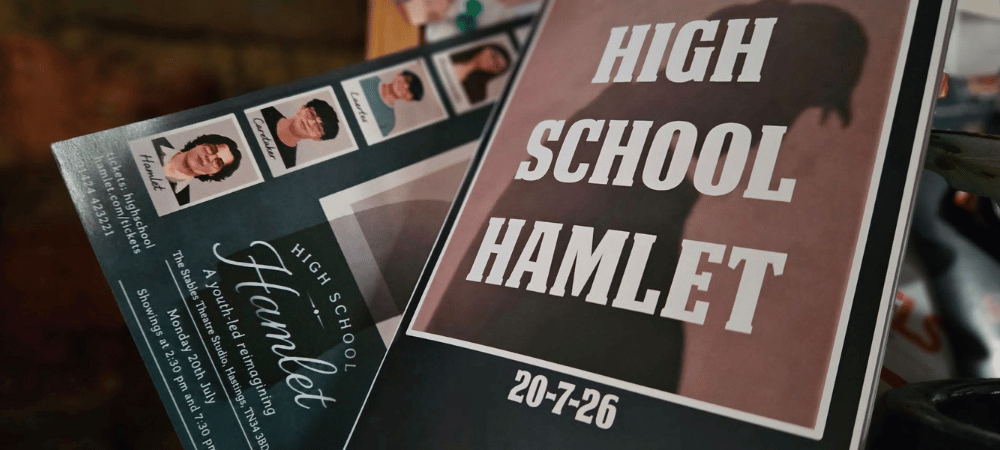
Poster by Jess Bridger (Instagram: memoirs.pdf).